Tuesday, July 08, 2008

The Global Circus

While travelling through Vietnam with Mrs Donkey over the last two weeks, I found myself reflecting on my personal growth over the past decade, and particularly how my understanding about people and the world has expanded, been challenged, altered and re-developed during that period. It was in Vietnam, ten years ago, that a young, naive, fresh-faced Donkey took his first fearful steps beyond his own cushy borders, into the so-called third world, and where he was first exposed to the attitudes, beliefs, practices and (non-) activities of the backpacker community ... t'was my first exposure to life on The Trail.

I can recall sitting on a boat in Halong Bay, all those years ago, surrounded by crew-cutted, tattooed, muscular British "lads", chain-smoking, guzzling beer and joking loudly about life on The Trail; diving in Phuket, trekking in Karakoram, beach parties in Goa, ganja in Thamel, ping-pong balls in Pat Pong, venereal disease since Bali ... being only two days into my own adventure, I remember feeling uncharacteristically timid beneath their monolithic self-confidence and bravado, and I wondered if I would ever be able to assimilate into multiple cultures and environments the way I imagined these seemingly older, self-sufficient, modern-day adventurers, and their gorgeous, bronzed, semi- (and occasionally) naked, nubile female counterparts had been able to.

Before long, like so many inexperienced travellers before me, I signed-on as an apprentice; I sat at the feet of my betters, and I began my learning by lapping-up all the bawdy tales of life on The Trail. As befitted my role, for hours I listened, bewitched, as I learned of daring escapes from corrupt customs officials, of ways to ensure you don't get ripped-off by vendors and rickshaw drivers, of where to go to buy the cheapest chapattis, of how to smuggle beer into Pakistan, and through all of the lessons, I respected and worshiped my new teachers as one reveres a wise and noble sage.

Before long, I too found myself wearing the voluminous, earth-coloured hemp trousers and brightly striped, cheese cloth shirts of my betters. Before long, I too had neglected my bodily hygiene, and been content with sleeping on mattresses containing a menagerie of microscopic fauna. Mirroring my fellow disciples, I allowed my stinking body to waste away to skeletal proportions, and before long, I too had succeeded in shedding my materialistic ways, and had altered my life so as to live my life exactly as poor people do in villages, all over the world

For example, each day I would sleep late, and rise in the late morning with an almighty, beer-fuelled headache. Wiping the crust from my eyes with my sleeve, I would dress in my unwashed "uniform", and sit down to a large plate of banana pancakes and a papaya milkshake. As I sat, I would look through the Lonely Planet and decide what I was going to see and do that day, and then I would dig into my pocket to discover that if I did any of the things on my list, I would not have enough money left with which to get drunk and stoned that evening, and so instead I would open my travel journal and spend the rest of the day reflecting on the evils of the materialistic west.

Occasionally, were I lucky enough to save a couple of pesos, ringgits, rupees or yuan during an argument with a rickshaw driver on a given day, I would endeavour to head to the market to purchase a souvenir or two in the form of some of the typical objects that the local communities buy and sell every day. I would head out into the sweltering heat, and wander past an endless progression of stalls selling bright pink, orange and red bags, coloured, cotton lampshades spotted with reflective mirror circles, colourful juggling balls and firesticks and rows upon rows of garishly striped shirts and tie-up fisherman's pants. With these exotic, everyday objects and clothes, I would imagine myself in the future, having returned to my friends and family back home, describing to them how poor people decorate their homes, how they amuse themselves around the fire in the evenings, and about the clothes they wear while fishing. I imagined that my collection of exotic accoutrement would help to educate them about life in the third world, just as I had been lucky enough to receive this unique education.

Because, by the end of three months on The Trail, I had moved up the ranks from wide-eyed, adoring apprentice, to experienced, wizened teacher, willing to bestow upon others the terror, anguish and triumphs of my travels. Sure, I would occasionally need to relate an anecdote I'd heard from others, substituting the original protagonist for myself, but when assuming the role of the adored sage, it is important to be able to fulfil people's learning requirements, and besides, I was sure these things would happen to me eventually, as many adventures still lay before me. Because by that time, I had decided upon a life on The Trail. I would forever be a traveller, a nomad; no longer a prisoner to the materialistic, meaningless society from which I had come, but a fully-fledged member of a new, more aware population, one not determined by geographical borders or by race ... I had chosen to belong, forever more, to the Global Community ... at least, I was going to ... just as soon as I could scrape together some more cash.

And for that I needed to go back home to the capitalist heartland. Through my newly heightened awareness, I struggled miserably to work each day through bumper-to-bumper traffic in my ridiculously huge, fuel guzzler, and I suffered through day after day of meaningless boredom in order to line my pockets with enough money to allow me to once again experience the consciousness expansion of The Trail.

In the end, getting back on The Trail took me a good few years, side-tracked as I was by the arrival of the Xbox, the Holden HSV Commodore, numerous football seasons, nights at the pub, beachside holidays etc. But through this time, I was careful to cultivate the worldly understanding that I had acquired on The Trail, and to remain pure to the ideals of living simply, and denouncing materialism in favour of the simple, village life. I also continued to place upon a pedestal those great and intelligent individuals on The Trail (amongst which I now included myself), who knew all there was to know about getting from A to B, about crossing illegal borders, about catching planes, boats, cars, busses, rickshaws, motorbikes, bicycles etc, and most importantly, about how to live just like the communities in third world countries. I admired these people (and therefore myself) for all of these things, and especially for their ability to blend-in - almost disappear - in the counties they visited. I was itching to get back on The Trail.

But things don't always turn out as you'd expect. Rather than donning the hemp and allowing my hair to get all greasy and matted, I was given an opportunity to go to a very different part of the world to work. Here I was surprised to find available in one, dusty corner of the market in that very distant, and culturally different country, the same brightly coloured shirts and oversized pants that I'd worn on The Trail. I also found, beneath the dust, sparkly, mirrored lampshades, juggling balls and garish bags. I was a bit perplexed to find these objects in my new home, however I knew that travel was all about discovery and solving mysteries, so I purchased a pair of incense-reeking, ochre-coloured hemp pants, and accepted my first dinner invitation to a colleague's home.

Here I was surprised to find kerosene lanterns, and nary a spangled lampshade in sight. My host's family, all dressed-up in pressed trousers and shirts, sat around watching TV, and appeared somewhat annoyed when I produced juggling balls from a fold in my ridiculous trousers and began hopping on one leg.

Lying in my bed later and reflecting upon that excruciating evening, I found it difficult to marry what I had seen and experienced in my colleague's home with what I thought I knew about how people lived in the third world. Years later, I found myself living in another, what I then knew to be called "developing" country, and sure enough, in the market, I found stalls selling the now familiar pants, balls, lampshades and bags, and yet I never once saw anyone from that community wearing such clothes, or decorating their homes with these objects.

Years after that, I found myself back in the country where my eyes had first been opened to the ways of the world, all those years before, and the penny finally dropped. Here I discovered that the local community, far from wearing the baggy pants and striped shirts that I had worn, actually despise these clothes, and the people who wear them. I came to understand that banana pancakes and papaya milkshakes are served-up for breakfast in only one street in the entire city - that street of course being where all the backpackers stay. And most interestingly of all, I discovered that fishermen wear shorts or sarongs while working, and pressed, pleated trousers at home, and that anyone who wears bright coloured clothes and juggles balls on one leg is thought of as having escaped from the circus.

Donkey never pretended to assume that he was all that bright, and it has taken him a long time to come to realise that the Global Community, those young (and occasionally, not-so-young) men and women who you'll find on The Trail, far from adopting the practices and behaviours of the communities in the countries in which they find themselves, are viewed by their reluctant hosts as alien freaks, more a product of a circus sideshow than a participating member of their community. It has taken me a long time to realise that these ridiculously dressed, stinking, filthy, pompous, obnoxious, privileged and self-obsessed animals, while they form a community of sorts, should more accurately be described as belonging to the travelling, Global Circus.

Over the next few weeks, I intend to celebrate my return to DonkeyBlog by introducing you to some of the characters I have met on The Trail, and exposing these for the circus sideshow freaks that they are. The carnies have arrived at DonkeyBlog, and the big top is being arrested. Welcome to the Global Circus.


Yep, because people always walk around the village looking like this. Pic: http://www.rawganique.com

Sunday, May 25, 2008

It's just a jump to the left...

After the sky-scraping, stiflingly hot, hectic buzz of Bangkok, it was a fantastic treat to slide across the border last weekend for a couple of days in Vientiane.

"There's noting to do there, y'know," they all told me, as they drew on their great tumours of fruit metastasising from ridiculous cocktails in the slick, marble-lined bars of Bangkok's fancy hotels. "It's like going back through time to a country town in the '50s". Sounded pretty interesting to me, and I was sure a town isn't dubbed "The Paris of the East" for nothing ... although I think that term may have been attributed to at least half a dozen other places I've visited in the last couple of years. Still, it was worth a squiz, so I donned my best 50s gear, slicked my donkey mane up into a great, greasy wave, and took to the open road.

The "highway" into Vientiane certainly checks out with the idea of a country town in the 50s. I remember seeing old photos of my parents' house, just after it was built in the mid '60s. It was on one of those new, outer suburban housing estates, and theirs was one of the first to be completed. I recall this one photo of my Old Man, wearing a pair of tight, checked bathing shorts, mutton-chop sideburns like a couple of dead possum carcasses hanging from a shed wall, and a grin from ear to ear as he proudly presents his own bricks and mortar. Behind him stands his beige-brick castle, and beyond that ... nothing. Apart from Mum and Dad's house, there was nothing but empty paddocks, as far as the eye could see.

Fifty years later, as my fat, Donkey ass was turning puce with each jolt of the rickety tuk-tuk, my occasional glimpse of the landscape outside revealed a copy of those old photographs. Something seemed wrong – Vientiane was a capital city, and my guide book told me it was a 30 minute ride from the border to the centre of town. We'd been travelling for 25 minutes by this time, and all I could see through the spaces between the rickety buildings lining the Friendship Highway, was paddocks. Surely we should have been in the outer suburbs of a great, Asian, urban sprawl by this time? Thinking I'd been conned like so many inexperienced tourists before me; that I was being taken on the long road via Mandalay, where I'd be bashed, raped and sold into slavery, an embarrassed rage leapt to my cheeks, and I began pounding on the window of the driver's cab, shaking my fist at him in fury.

The poor little fellow immediately pulled over, and was nearly crying as I threw a bunch of notes at him and stormed off along the road with my backpack.

By the time I had paled a little, I found myself walking along beautiful, tree-lined boulevards. Where these grand promenades began was not discernable; the rickety, paddock-backed shops simply vanished, to be replaced by moulding, but immense, stately homes. I panicked that maybe I had accidentally evaded a security check point, because it was clear I had wandered into an exclusive area in which vehicular traffic was forbidden. Later I learned that I had finally reached the centre of Old Vientiane; the driver had been doing the right thing after all ... but still, something was not quite right. Where was everyone?

And that's about the first thing you notice about Vientiane when you arrive – there's no one about. For the next twenty-four hours, I reasoned with myself, "Oh, it's Sunday, people must be inside relaxing" ... "Oh, it's only early on Monday, perhaps work starts late here"... "Oh, perhaps they don't leave their offices at lunch time, but eat at their desks", however by "peak hour" on Monday afternoon, there was no denying it – just like a 1950s country town, only a few vehicles exist in Vientiane, and the population is really very, very low.

But fortunately for Vientiane, and for a visiting Donkey, there are some really great things to remember about the '50s. For starters, one is able to walk right down the middle of the road, completely unmolested by traffic as one gazes into the canopy of overhanging elms (not yet cut down to widen the bursting arterials and to make way for electricity wires). You also get to sit in the open air at one of dozens of wonderful, alfresco cafes – say what you will about the French and their [lack of] manners – of course, I never would – but their culinary legacy is one to be applauded. For mine, sitting back at a gingham- clothed table on a neat little sidewalk while eating exquisite baguettes and sipping on the finest coffee in Asia is truly a delight in the literal sense of the word. And the best part of 1950s rural culture, is that they are unashamedly vocal about their hatred of foreigners ... especially Europeans, so you get all the joy of French cuisine, without the scowls, cigarettes and unwashed bodies. Magic!

But in case you needed just that little bit more evidence to convince you about Vientiane's time warp, allow me to share with you the contents of the laundry price list I found in my guesthouse bedroom. It looked much the same as any other laundry list, anywhere in the world, although very much at 1950s prices (did I mention that Laos is very cheap?). I scanned down; trousers, skirt, dress, shirt, t-shirt, safari suit, socks, underpants ... hang on, what? A safari suit? You mean to tell me that people in Laos still wear safari suits for events other than fancy dress parties or to play military board games and toy soldiers with their nerdy mates?

After two days of wandering around the quiet, but elegant "Paris of the East", I am prepared to concede that Vientiane is very, very much like a country town in the 1950s, not only in its appearance, but in its attitudes and its fashion. Of course, your urbane, cosmopolitan Donkey didn't quite fit-in with the quaint scene, but as soon as I get myself a pair of long, khaki socks, a pith helmet and a beret (the later to be worn on casual Friday) I'll be ready for an alfresco croissant extravaganza. I'll be oooh-la-la-ing with the best of 'em.
Have a look at the size of that baby! Vivre le France! Pic: Hagas

Wednesday, May 14, 2008

UNequality

Ever been to a UN meeting? They are a microcosm of a system gone wrong; a system which is representing us all … every day.

Yes, the United Nations; founded in 1945, with a mission to (and bear in mind that I am seriously paraphrasing here in order to support my rather distorted, and not necessarily accurate opinions), “…work together as a collective of nations, in order to strive for and achieve equality of nationhood for all the citizens of the world”. Or something like that, anyway.

Well I can tell you right here, that 60-odd years down the track, there’s still a lot of work to be done, not just in the world … I’m not even going there … but in terms of equality within the UN … hell, even the pissy meetings that Donkey gets to attend are shamefully inequitable.

Take today for example, the room was full of representatives from about 15 different UN agencies, and approximately 25 other organizations made up of non-government organizations (NGOs) and the press, and believe me, there’s a serious pecking order to these events. For starters, the latter two groups are distinguished from the UN bods because to work in the UN, it seems you have to wear an Armani suit to work every day. So right from the starter’s gun, every UN representative in the place is looking sharper than Sweeny’s razor and smells like the ground floor of a flashy department store.

By contrast, all the journos in attendance are haggard, chain-smoking, hard drinking types whose eyes (perhaps an effect of reporting from too many armed conflicts) don’t seem to be able to remain still for more than a quarter of a second. These men and women party every night like there’s no tomorrow, ‘cause for some of them that’s probably true … but bearing in mind that they turn up to these meetings each “tomorrow” morning, they rarely seem to have much to contribute; they are generally as unwashed and unironed as their clothes.

The NGO people are pretty freaky, too. Most obvious are the Frenchies. They are always blokes – so much for Liberty, Fraternity, Equality … you will hardly ever see a French woman at one of these meetings - it’s a damn shame, too, ‘cause while we’ve all heard that French birds are pretty hot … the evidence on show around here suggests that French men certainly are not! They are almost always unshaven, and their facial stubble is only slightly shorter than their unkempt crew cuts, giving their heads the ludicrous appearance of a rotting kiwifruit the size of a football. Their faces are long and haggard from incessant chain smoking (tautology?), and their sunken eye sockets have the uncanny resemblance of a recovering crack addict. To a man, they cannot iron a shirt to save themselves, and the only words we non-French speakers can understand from them (which we hear every couple of minutes) are, “But, it is not the way we do it in France!”.

The other NGO males in attendance (ie, the non Frenchies) look like a bunch of University students who stay up all night smoking pot and playing Xbox, and, after over-sleeping, rush through three different Starbucks on their way to the meeting – very wide-eyed and jittery. The girls (again, not French) are all hippy love-children, wearing fisherman pants and cheesecloth shirts, with dirty, matted hair.

The only exceptions to this stock of hard-core NGO workers are the Christians. Think colourful overalls with bright patches on the knees. Think, fresh, unblemished skin and pearly smiles. Think group hugs, back rubs and a tendency to pull out a guitar for a bit of Kumbayah during the breaks.

Clearly, the journalists and NGO people are quite distinctive compared with their well-dressed and groomed UN hosts, so it’s no wonder they remain oppressed and bitter about their lowly place in the International Humanitarian and Development pecking order. But even within the UN system, despite decades of “beating down the walls of inequality” (paraphrasing again), the pecking order between agencies is just as strong and deeply rooted.

Take the WHO reps, for instance. These are invariably stuffy, old, South Asian doctors with bushy moustaches and shiny pates (in stark contrast with their crimson, hennaed back and sides). Their huge, protruding bellies, which rest on the groaning desks before them, are only slightly larger than their arrogance, which is exercised every five minutes by talking over the top of whoever’s speaking (unless it’s one of the token men - yes, always a man - who regularly seem to be visiting from Geneva, in which case they will fawn and kowtow like a favoured head-boy before the principal, and will not speak unless spoken to).

The token guy from Geneva is usually French or Swiss, fat and sporting a Super Mario moustache. He is often wearing an ill-fitting brown suit, and always seems to fall asleep with his mic on. It is truly a special sight, I can assure you, to watch the bulging temple arteries of these UN officials as they try to get through a one hour meeting while Fat Fritz snores and slobbers all over his desk at 300 decibels! These are people whose intolerance for insolence or incompetence (real or perceived) would normally provoke a sharp, verbal, public dressing-down, and their anger and disdain is almost palpable, but what else can they do but strain to keep a lid on their boiling resentment? He’s from Geneva, after all!

Then there’s the UNDP and UNESCO people … these seem to be the agencies that allow women into the mix … and they have to be real, hard-arsed bitches to bust through that thick, bullet-proof glass ceiling. They often hail from African countries, and with the exception of their amazing, beaded hair dos, they wear straight-up-and-down, black or navy suits with E-N-O-R-M-O-U-S shoulder pads. It’s possible that these women would have some useful things to say, but because this is the UN, I guess we’ll never know.

And it goes … the UNAIDS people have nicotine-stained beards; the FAO mob are uber-trendy Italians; UNHCR seem to be long, thin and drawn and UNIFEM are all lesbians (not really … I just thought I’d say that ‘cause I was running out of descriptions and I thought it might get some noses out of joint).

And the entire show is run by a debonair, European gentleman who is all polite smiles and condescension, who looks like he’d be pretty keen to wind the whole fiasco up and retire to his office with The Guardian under his arm and a nice, thick-bottomed tumbler of single malt in his fleshy hand. He is ably assisted by the most stylish, young Englishman since the stem cell people mastered the Colin Firth and Hugh Grant graft. His snide, offhand dismissal of just about everyone suggests he grew up at a place called Longbourn*, and was the thirty-eighth generation in his line to lead the First VIII at Eton. I guess he’d have to be … no one that young reaches those heady heights in the UN without a decent boost from a substantial, royal lineage.

And that’s how it is … at every meeting. Everyone has a place. Everyone is mutually polite on the outside while they seethe with loathing beneath the surface; frustrated that although they hate everyone from every other agency, they’d gladly denounce their colleagues for a leg-up the ladder to join them. And these are the people, appointed by our own elected statesmen and women, to represent our nations’ interests in working together in harmony to promote equality amongst all the nations of the world.

Would I wanna be a part of that? You betcha! Get out of my way, you French, female, journalist scum!


* One for the girls there - just trying to make up for that UNIFEM comment before.


It's the Christian NGO workers that you really gotta watch out for. Pic: http://img.metro.co.uk

Wednesday, April 30, 2008

Subliminal [BUY COCA-COLA] messages

What would you call a fully-grown, so-called masculine Donkey who cries at the movies? Yeah, well I’m sure there are plenty of names one might use, but we will refrain from using them here for fear of substantially lowering the tone of this forum.

Now let me ask you this; what would you call a fully-grown, so-called masculine Donkey who cries at the movies … while he’s watching a children’s film?

Soft cock! Pussy! Woos-bag! Sook! Wanker! Sheila! … and the list could go on.

But I must confess that while taking my niece to the movies on the weekend to see Horton, the animated Dr Seuss story of an elephant who learns of another, microscopic world on a speck of dust and puts everything on the line to save it, that’s exactly what I did. I became a ridiculous, snivelling, blubbering fool. Quite pathetic, really, and definitely an incident which needs dissecting, ‘cause it’s a pretty disturbing scenario.

Even as a youngster, I was fairly sceptical of my mother’s ban on toy guns. I mean, I might have been young, but I fancied I knew the difference between a plastic piece of shit and a real, working gun, and I never understood or believed that there could be any danger in playing with the former, given I was not the type of foal who was inclined to want to kill anybody.

I maintained this stance for many years, and as a much older Donkey, I remember getting abused to within an inch of my life one evening by an irate taxi driver who’d been listening to talk-back radio for an entire twelve hour shift (enough to make anyone go on a shooting spree, I reckon). After settling myself drunkenly into the passenger seat, I picked-up on the radio topic at hand, which was about Power Rangers and other children’s toys which, according to late night, right-wing consensus, promoted violence. Well, being the all-round great Donkey that I am - the People’s Friend, as I like to think of myself after a few hundred beers – I decided to weigh-in and slur my opinions on the matter, saying, “Awrrr come-on ‘ere a minutsh. Dese bastardsh dunno what dey’re talkin’ ‘bout ‘caush kidsh dese daysh dey not shtupid an aren’tsh gonna fink toysh ish gonna make em do violencsh … hic!”.

What drunken Donkey wasn’t so great at reading at 4am on a Saturday morning was that the driver happened to be one of those “bastardsh” who was sticking with the consensus, and he let Donkey have it in no uncertain terms, demanding what an up-start, drunken, silver-spoon-up-his-arse, Eastern suburbs piece of shit would know about raising kids anyway, to which I responded with a contended snore; and courageously feigned sleep all the way home, just in case he decided to hit me.

Anyway, the point here is that for so long I’ve been pretty unbelieving about the effects of subliminal messages, and it is with that attitude that I took my lovely niece along to see Horton on Saturday morning.

It’s a great movie, I must say. Full of humour, colour, great images, sounds and movements. A great, fun story. Unfortunately for Donkey’s reputation as a fine, up-standing, unworldly, sport-loving homophobe, it also carried a very powerful subliminal message which had such a profound effect upon me as to transform me into a sobbing, weeping mess.

Basically, the movie brought home a lot of the issues that I’ve been dealing with (and which I am obviously far from having dealt with) over the last couple of months. Now forgive my attempt at subterfuge, here, but I have to be very careful with how I say this. Basically, Horton the Elephant, after discovering the town of Whoville, which is a microscopic world living on a speck of dust, comes to the realisation that every life, no matter how small or different from our own, is worth saving, and just because you can’t see or hear it, doesn’t mean it doesn’t deserve to live. Fair enough! But the protagonist in the movie, an uppity Kangaroo, is so reluctant to allow that to happen, for fear of it leading to anarchy, that she is willing to allow … no, encourage out-and-out lawlessness to prevent it.

As the movie unfolded, I couldn’t help but read in that message that the Kangaroo was reminiscent of a very influential, [emerging world economic power] which I have had a bit to do with lately, and that the tiny world of Whoville, out of sight and out of mind on the speck, turned my tearful thoughts to a small [region within that emerging economic power, which is said to enjoy some self-determination].

As I blubbered through the colours and images, I watched as all attempts were made to keep this [so-called, self-determining region], like Whoville, far away from the eyes and ears of the rest of the Jungle of Nool’s animals, for fear that their new and misunderstood ways may change the order of things, resulting in anarchy throughout the [emerging, economic] Jungle of Nool, and in order to prevent this anarchy, I watched as the Kangaroo, the leader of the [emerging, economic] Jungle of Nool, led the rest of the animals of Nool on a rampage of hatred and revenge, inflicting all manner of violence against Horton and the inhabitants of the [so-called, self-determined region] of Whoville.

Some of you will know where I have come from recently, and perhaps you can appreciate that I have witnessed the animals of the [emerging, economic] Jungle of Nool, whipped-up into a fearful frenzy, inflict all kinds of atrocities on the people of the [so-called, self-determined region] of Whoville. I am afraid as I sat, mortified, in that Bangkok cinema on a Saturday morning, that the whole thing was just a little too much to hold in.

Fortunately for me, it was pretty dark in there, and my niece was too wrapped-up in the colours, images and sounds to notice my shuddering form beside her. But clearly there is a message in this film which, if it hits the right mark, can have a very profound effect. It seems that the focus of discussion around subliminal messages is usually on the negative influence they have on young people, but who’s to say that they cannot be used to do some good in the world? While the messages in movies like Horton may go a bit over the top of young kids like my niece, perhaps they will embed somewhere in their brains and hearts which may, as they grow to take their place in their communities, lead to a much better world than the one we are living in at the moment.


The Mayor of Whoville; one of the colourful, wacky characters in Horton, which had Donkey sobbing in his popcorn. Pic: www.imdb.com

Saturday, April 26, 2008

Human Development 101

I guess I shouldda known that a hot-tempered, short, fat, Sri Lankan science teacher, who was renowned for violent outbursts at even the slightest snigger from a twelve year old wasn’t going to be the best Human Development teacher of all time. If not his nervous, embarrassed persona, then his near-fatal treatment of poor Mark Kennard who thought the 80s animation of a woman’s breasts growing through puberty was pretty funny, should have confirmed it.

Because of Mr Peters’ utterly inadequate delivery of the subject, I was completely taken by surprise when the wet dreams, curly hair and body odour arrived thirteen years later (OK, I’m a late bloomer), although I am still waiting for my Old Feller to grow, so he obviously got that message across alright - it was a triumphant night in the Donkey household that night, I can tell you! I can remember delivering victorious air punches all the way home from school … but I now realise it was just another betrayal of a pre-adolescent’s trust.

As was the complete lack of information of what was really going to happen to my body. Sure, they tell you you’re voice is going to break, your balls are gonna drop and grow to the size of footballs, that yer knob would become a raging python and that you’d get hair on yer chinny-chin-chin, but all those were supposed to make you sexy … were things to look forward to. But what about the rest of it?

No doubt some hot-shot lawyer for the Christian Brothers whose court-room skills had been honed for his clients thanks to an excess of other legal proceedings in the last decade, would say, “Well, my clients never actually told you any lies about what would happen to you”. Agreed. But what about all the info that they DIDN’T tell us?

I mean, not a week goes by now that I don’t recognise something new and unexpected about my body. “You’ll grow hair on your chest and face”, they told us – great, but what about my back, shoulders and nose? Before long I’ll have to sink to that depth where I am forced to whisper in the ear of an attractive young hair dresser, “Just give me ears and snoz a trim, too, would ya Love?”.

“Your voice and testicles will drop down”. Sure, that’s good to know, but why no mention of descending man boobs and huge, flaccid jowls?

“You’ll grow thick hairs around yer … um … thingies”. OK, that would have been a good lesson during which to have paid attention, but I’m sure I would have perked-up if someone had mentioned an Afghan carpet emerging from my arse! And why exactly does it have to have migrated from my scalp?

The lawyers may well be right; the Christian Brothers didn’t actually tell us any lies, but they certainly neglected to tell us that in a few years, we’d all be turning into our fathers! Bastids! No doubt the concealment of these many facts was some innovative form of youth suicide prevention, but just because people don’t throw themselves off a bridge on Brother So-and-so’s watch, doesn’t mean they aren’t going to try it later, when, at the age of 27, the realisation finally dawns.

Fortunately, the breakthroughs in male grooming technology and practices driven by the metro-sexual revolution can be employed to keep the wolves from the door for most manifestations of male aging; home nasal-hair kits can be used for most orifices, the front, back and crack wax, available from all good beauty salons, can have you looking like Thorpie in a matter of minutes, man-bras can be worn discreetly to the gym, and there are pills to correct those other unfortunate effects of gravity.

But this week I received yet another unexpected, crushing blow to my dwindling, youthful vigour, taking me just that one step closer to looking like my father, and this time, there’s not a gadget in Christendom which is gonna help me to stay looking young. This week my recent suspicions were confirmed when I discovered yet another change in my aging body. The change this time wasn’t my vocal chords, my balls, my willy, chest, back or arse. This time the change was in my ears.

What those bastards at the Christian Brothers school don’t tell you is that, as you get older, a blokes ears change so that every time he goes into the water; at the beach or at the pool, water gets in and doesn’t come out. So next time you’re down at the local pool, and you’ve had your swim, taken a shower, and are heading out to the car, don’t avert your eyes from all those sad old farts huddled together near the door, their torsos bent sideways so that their heads are parallel to the ground as they bounce up and down on one leg. You never know, one of ‘em could be yer old mate, Donkey!


Oh, and by the way, regarding the crappy 1980s breast-growing animation, it’s one of growing-up’s great releases to reach that age when you actually feel comfortable with saying that, “Yeah, Mark Kennard was right – it was farking hilarious!”. God rest your poor, maimed soul, Mark!


Ear hair - one of the unsung effects of male aging - very unattractive indeed. Pic: http://news.bbc.co.uk/nol/shared/spl/hi/pop_ups/05/health_guinness_medical_record_breakers/img/1.jpg

Tuesday, April 22, 2008

Red means DANGER

I regularly slip back to the glory days when I was a rosy-faced chum strutting up and down the ancient, hallowed halls of La Trobe University*, rocking-up to lectures with a hangover every day, starting food fights in the cafeteria every lunch time ... to me, it really doesn't seem like that long ago. But every now and then I think about something which jars me into realizing just how deluded I am about my age. This happened on the weekend, when a chance remark from a friend made me think back to the first time I ever saw or heard of the internet – it was on the last day of University! Can you believe that? Fark, the world's gone mad – how would any of us cope nowadays if we didn't have faithful Google by our sides?

It’s a massive change! We're completely reliant on the internet now. It was not all that long ago that parents were denying my generation the use of computers because they were only good for playing games, and thus interfered with their child’s learning. Nowadays, at least in most developed nations, parents who deny their children access to the internet are all but gaoled for breeching the International Convention on the Rights of the Child. Technology’s like that. It forces societies to change the way they think; not just a little bit, but often to the extent of a complete 180 degree turnaround.

Take another example. Today I was wandering around the hideously inflamed, herniated shopping mall that is Bangkok, and I watched as these two young people purchased mobile phones that were so small as to actually fit into that (until now) useless little pocket that you find in the front of a pair of jeans, y'know, that one inside the main pocket? Yeah, well it got me to thinking that only 14 years ago, all the guys I used to work with carried around those Motorola bricks which, if anyone were lucky enough to be able to stuff one into their pocket, would find themselves on the receiving end of substantial community backlash against inappropriate displays of crack! ... and only 2 years before that, there was no such thing as a mobile phone at all! Back in the ‘90s, mobile phones in the workplace were banned for fear of wasting valuable company time. But just try getting a job nowadays if you’re unable to supply your prospective employer with a mobile phone number. Technology has changed society’s views so much that what was previously thought to be a bad thing, is now mandatory.

But y’know, with technology, there’re always the stragglers – the people who are stubbornly unwilling to embrace whatever technological revolution the kids are into this week. They believe they are making a stand … that their refusal to adopt the technological change will maintain some notion of how society “should be”, but they just don’t get it. Technology’s not there to hurt us, it’s there to help us … all of us. And what these selfish ignoramaii need to understand is that for one person to deny this fact, and to refuse to embrace technology, they are not only denying themselves the chance of a better future, but all those around them as well.

My case in point is the extremely traumatic impact that one man’s refusal to embrace the technological advances in male swimwear had on poor ol’ Donkey recently. But first, let’s just have a quick appraisal of where technology has brought us in that department. If you thought Donkey had been chastised enough in his youth for being short, fat, bald and smelly, for speaking in a high-pitched, whiney voice and for his penchant for the taste of his own nasal mucous, then you must understand that the social exclusion he derived from these qualities was as nothing compared with the effect of being forced by his unfashionable mother to wear a pair of stripy blue, white and grey Speedos to the beach or pool, every summer of his life for 17 years.

Speedos, Australia’s gift to the world when first released on the market in the 1960s, were designed to maintain maximum modesty, while ensuring minimum drag as they cut through the water on some buff male lifeguard.

Back in the 1960s, although shocking to the world at the time, these tiny garments were actually pretty substantial, but as the years went by, and as nylon technology improved, Speedos became considerably smaller and tighter, and soon adopted a cultural identity all of their own, assuming names such as dick-stickers, budgie-smugglers, the packed lunch, dick-pointers, sluggoes, lolly bags, banana hammocks and slug-huggers.

Unfortunately for Donkey, the 1960s were only just before the 1970s, and while the new and improved Speedos were on the store shelves by the time I needed to avail them, you could still find some of the original models if you shopped around a bit … and they were usually really cheap. As well as being unfashionable, Ma Donkey was also a bit of a tight-arse, so that’s what Donkey ended up with; a great, big, saggy pair of blue, white and grey striped Speedos which, unlike their evolving successors, actually got bigger and saggier over the following 17 years as the nylon threads grew longer and eventually gave out.

Donkey’s reputation as being the only kid in the South Eastern suburbs not to get a kiss and a grope from the blossoming Susan Evans behind the kiosk at the Waverley Pool in the summer of 1986 aside, technological advances in waterproof fabric were going gangbusters in the 1980s, and the Speedos were getting smaller, sleeker and more fashionably designed each summer, with bright colours replacing the previously de rigueur navies, blacks, browns and stripes. Athletes were happy, the telephoto paparazzi anchored 6 miles off Miami Beach were happy and the emerging gay community was ecstatic.

Governments, eager to harness some political ballast from this swimsuit-led global euphoria, poured unprecedented reserves of public funds into research and development of even more high-tech, waterproof material, and before long, the technology had become so advanced, that a new, completely unpredicted swimsuit revolution was upon us, the likes of which had not been seen since the ‘60s. Just when the Speedo threatened to get so small that it was in danger of disappearing up some perfectly curved, muscular behind, the Teflon swimsuit arrived.

Within days, athletes in the pool were slashing Olympic records by a third, and the Skin Cancer Lobby snapped to attention and rode that unforeseen, financial coup like a raging Tsunami all the way up the beach and into the backyards and school yards of the developed world. Virtually overnight, this incredible, technological breakthrough in aqua wear led to a complete 180 degree turnaround in beach fashions from showing as much flesh as possible, to being covered up like Douglas Mawson in an Antarctic Blizzard. And as you all know, that’s how it’s been on the beaches of the world, from Mordialloc to Monte Carlo, ever since.

At least that’s what I had thought, until a couple of weeks ago. I’d been bashing out a couple of kilometers down at the local pool, powering along in my head-to-toe Teflon (blue, grey and white stripes – I may dress myself nowadays, but old habits die hard) and as often happens when one is breaking world land/sea speed records, my mind had wandered off to what crap I was going to write on my blog that week, so I didn’t take much notice of the bright, red streak that passed me on numerous occasions.

When I reached the end of the last lap, in a bit of a daze from my exertions, I went through my usual ritual to slow my heart down; blowing out all the air from my lungs and laying face-up on the bottom of the pool. I must’ve been there for a fair while ‘cause eventually I was woken from my contemplative state by the rapidly-approaching red streak. As it came closer, I was horrified to behold the disgusting sight of a pair of bright, red, poorly elasticized, vintage Speedos – I mean really, in this day and age!

My innocent sensibilities were certainly confronted, I can assure you, but Donkey’s basically a live-and-let-live kind of guy, so I tried to relax and arrest my escalating heart rate. Despite my best attempts to ignore the offensive sight, however, those red micro-pants seem to hold some kind of spell over me … they were like the Mona Lisa – I couldn’t escape that mocking stare, no matter which way I turned my head. As such, I happened to be looking straight up at them when their owner came out of his tumble-turn, and as he twisted out from the wall, there they were; a great big, greasy penis and a gigantic, hairy, wrinkled testicle, hanging out the side of the flapping red pant, and bouncing back and forth with each stroke as they swung off down the pool.

In my confusion and fear, I forgot my surroundings and let out a frightened sob, which was immediately replaced with about 300mL of highly chlorinated water. I dunno what happened after that, but the next thing I knew I was lying on my side next to the starting blocks while an attractive pool attendant was wrinkling her nose at the smell of my vomit, which had somehow covered her right shoulder and most of her chest in a chunky film.

Technology is there for a reason. Just as Darwin would argue that only adaptive beings will survive, people need to learn that technology, like evolution, is there to assist and enhance that survival, and to ignore it will kill not only you, Mr Inappropriate-and-Inadequate-Red-Speedos, but a poor, mentally scarred and innocent Donkey as well.


* that’s a joke, by the way – La Trobe is internationally maligned in architect circles for its mission-brown, square brick buildings … ok, I get it, not a very funny one.


Dick-stickers, budgie-smugglers, the packed lunch, dick-pointers, sluggoes, lolly bags, banana hammocks, slug-huggers … it’s not right, is it? Pic: http://www.yenmag.net/img/news/12/speedo.jpg

Saturday, April 05, 2008

The Hooley Dooleys MUST DIE!!!

After everything that Mrs Donkey and I have been through over the last few weeks, it has been very heartening and consoling to receive numerous phone calls and emails from friends and families enquiring about our physical and mental well being. Indeed we’re fine, both physically, and in terms of what we’ve been through, emotionally as well. However, something that does not seem to be understood by our loved ones around the globe, is the effect of something even more emotionally crippling than the rumble of tanks and the cracking of nocturnal gunfire.

Since being exiled in Bangkok, Mrs D and I have found ourselves living in the comfortable and welcoming bosom of my sister, her husband and their young children, the latter of whom are at that age where they have come to enjoy - who am I kidding? – have become tragically and hopelessly addicted to that relatively new phenomenon on Australian television, which features a number of idiots in primary-coloured tops dancing around a couple of would-be actors in fluffy animal suits. These singing and dancing, monochromatic acts have taken Australia (and in some cases, the world) by storm, gradually, stealthily creeping-up on our children like some destructive, mentally retarding brain cancer.

They’re all the same, following a tried and tested formula of bold, but contrasting colours on a more or less non-descript background; bouncing, repetitive movements; a couple of non-threatening, but equally colourful fluffy animal suits; and a collection of simple, catchy, repetitive tunes, all of which are designed to hypnotise or virtually paralyse anybody of a certain level of intelligence, be they young child or parent.

Interestingly enough, many of the boppy songs have a low-base, techno-like drum-beat which, when combined with bright colours and bouncy movements, has the exact same effect on children as it does on ecstasy-guzzling ravers – there’s a lesson in there for all you David Attenborough types.

Anyway, the whole point of these programs is that they can successfully send a rampaging two year old, hell-bent on destruction of every vase and electrical device in the home, into a docile, dribbling vegetable in about two seconds flat. It’s no wonder the programs have been adopted by exhausted parents everywhere as a surrogate baby sitter, however the problems begin when this helpful course of action gets abused, and these DVDs find themselves on high rotation, three or four times a day.

But for the uninitiated, let me offer you a nice, brief, un-biased DonkeyBlog explanation of this destructive phenomenon.

It all started, of course, with The Wiggles. Four washed-up, never-quite-made-it pop stars in different-coloured skivvies who thought it’d be a good idea to make up a few monotonously repetitive songs (not unlike their previous recordings) for the kiddies, only to become an instant, over-night hit, owing to their boppy tunes, saccharine smiles and muscular torsos (which succeeded in keeping the Mums very happy indeed). Their success was helped along by the introduction of a fluffy green dinosaur suit, a brown dog, a purple octopus, a red sports car and a fairly, implausibly peace-loving pirate. Their rise was dramatic and impressive. The Wiggles have now lent their images to a cartoon, and have spawned an internationally sought after merchandising franchise. They are, and have been for some time now, the kings of children’s television!

But poor old Sam, Murray, Jeff and Anthony are getting a little old, nowadays, to be still wearing those skivvies. It seems that their rapid success, having gone to their heads pretty quickly, soon bounced off their inner craniums, and headed straight for their waistlines, resulting in those slim, young bundles of smiling energy looking a little more like sad, leering, recovering alcoholics who seem to be getting just a little too close to those poor little children.

This metamorphosis, although having been missed by most parents who had stopped buying the DVDs after their first couple of releases, did not go unnoticed by entrepreneurial types in businesses suits up the high end of town, nor did The Wiggles’ rapid, multi-million dollar success, and before long, they had done their market research and introduced some new players on the scene.

First came HI-5; five young, funky things who looked like they’d strolled right out of a rave and into the studio – wearing Lycra, face paint and Indian bindis on their foreheads, they were a cyclone of fresh air, both for the kids and for the dads, who had grown tired of storming around living rooms while both child and wife sat transfixed, staring at the bouncing Wiggles with drool hanging out the corners of their mouths. HI-5 offered a little bit of titillation to the male parent, who soon became as hooked as their children on the monotonous, repetitive songs and movement of the new players. True to form, their wider-reaching appeal also spawned a merchandising success story, as the suits in glass building towers had predicted they would, and their cartoon likenesses, with their Manga-like, embellished lashes and cleavage, have also become a recognised trademark across the globe.

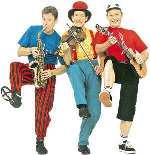
Perhaps a little late on the scene, but also following the formula of coloured shirts, fluffy animals and catchy tunes, were The Hooley Dooleys. Unfortunately for them, they have missed the cartoon likeness and merchandising boats, preventing their ever becoming overnight billionaires, however their delayed debut on the competitive, infant-mind-control scene has given this never-quite-made-it country and western trio plenty of time to do their homework, allowing them to produce a product which, through calculated, mental manipulation, will guarantee them ongoing DVD sales, and a very comfortable early retirement indeed. It is The Hooley Dooleys which Mrs Donkey and I have been exposed to in considerable doses over the last two weeks. I have come to respect and fear them in a way that I would any evil, criminal masterminds, and I will state emphatically and passionately right here as I massage my mental scars, that The Hooley Dooleys MUST DIE!

At first glance, such as when, as a parent, you are trolling the children’s DVD section of the local store looking for something fresh and new since Baby Grumbles outgrew twenty-odd DVDs of The Wiggles and HI-5, you would see that The Hooley Dooleys are a pretty safe bet for your little one – all the usual elements are there; primary coloured shirts, a fluffy kangaroo and a big, purple teddy bear. They sing, they dance and it’s all good. Even after you get it home, and see that the first couple of viewings result in the desired effect (ie Bubs drifting off into gurgles and a coma), you’ll be happy with what The Hooley Dooleys have to offer.

But it’s after the third or fourth viewing that things start to appear … well, not quite right. The first thing you notice is that these guys are a bit creepy; they wear the coloured shirts, sure, but they also have some pretty strange, very high pants on. One guy always wears a hat, but during one scene, he takes it off to reveal a shiny pate, and a long, flowing white mullet down his back. To make him seem even stranger, while the other two are wearing the crazy, wacky high-pants, he’s simply sporting a black pair of shorts – did you get that? Bald + mullet + shorts = keep him away from my child!

Other things, at first glance, appear normal too, but they’re not. As I mentioned, tall, fluffy animals – a kangaroo and a big, purple teddy bear. But as one gets to know the Hooley Dooleys, one learns that the teddy bear is not a teddy bear at all, but something called a Doodad. The Doodad’s name is Tickle – are you hearing this? Tickle the Doodad. Hmmm.

The Hooley Dooleys have even followed the tried-and-tested formula of multi-cultural diversity, by having one member whose country of origin is not Australia; The Wiggles have Jeff, from an unidentified Southeast Asian country, and HI-5 have the exotic, sexy and provocative Asian play-thing, Kathleen. The Hooley Dooleys have Antoine, a Frenchman who happens to be the owner of the afore mentioned mullet and inappropriate trousers. But The Hooley Dooleys go one step further than their peers by making repeated reference to Antoine’s nationality, and by performing songs which are designed to teach kids French. Why? I couldn’t imagine, but it is consistent with the French Government’s global commitment to promoting French language and culture – could it be that The Hooley Dooleys, and Antoine in particular, are a French Government plant, in order to brainwash our children into blowing-up socially motivated minority groups, embracing nuclear testing in their own backyards, smoking at the dinner table and basically being loud and obnoxious at every opportunity? It certainly makes you wonder.

But inappropriate fashion, sexual innuendo and international conspiracy aside, the real problem with The Hooley Dooleys is their blatantly manipulative, hypnotising, brain washing music and dancing. I have been exposed to this horrifying social experiment for the past two weeks, and I can barely function. In the morning, my eyes haven’t yet been cleared of gunk before I am singing that stupid We are the Hooley Dooleys song. On the bog, I find myself humming The Lunar Beat, and by shave time, I’m shaking my arse to the BOTTOM Boogie.

At breakfast, I sit comatose beside my niece (who’s halfway through viewing number one for the day) and forget to drink my coffee, and when I finally wander off to work with my headphones in my ears, I find that even the whine of Bob Dylan can’t cut through the friggin’ Jungle Boogie that’s splitting my skull from the inside out. It goes on all day! The slightest reference tips me off into more Hooley F’n Dooleys! And I’m a grown, arguably educated Donkey! Imagine what this crud is doing to a developing, moulding mind … to the minds of an entire nation of young people! We’re talking about opium (kiddie formula) for the masses (of children aged 1-3).

Something has to be done before my, and Australia’s future leaders’ minds become Hooley Dooley mush. The Australian broadcasting censors obviously can’t be trusted to prevent this kind of dribble making it through the net, and it’s now being marketed to offshore audiences. All children, everywhere are at risk. The Hooley Dooleys must be stopped, and I call on the United Nations - on UNICEF to do something about it. The Hooley Dooleys MUST DIE!

But perhaps, if death by firing squad is not appropriate for those who commit systematic infanto-genocide, an International peace-keeping force to Australia to surround the homes of the Hooley Dooleys and place them under house arrest is indicated (that is if they haven’t already fled and been granted asylum in French territory in the Pacific by Antoine’s corrupt, high-ranking Government official brother). Yes, an International peace keeping force is just what we need, and I for one would be willing to assist with selection of an appropriately diverse peace-keeping contingent, complete with military personnel from a range of nations, including a couple of trigger-happy, Chinese PLA soldiers. Antoine, you bastard. I’ll give you Bubble and Squeak every day of the bloody week!


Bald + mullet + shorts = keep him away from my child! Pic: http://15min.org/images/t_2001-11-28_03.jpg

Tuesday, March 25, 2008

Doctor Do-nothing

Sometimes it's not easy being a doctor ... especially when you're looking after a really sick person. Take this poor bugger I'm looking after at the moment. Firstly, it should be said, he's not frail or sickly, in fact, to look at him, you sometimes get the impression that he's eaten every pie in the shop! He's huge – certainly the biggest I've ever had to work with. And to say he's sick is not necessarily true either ... well, at least that is if you take the definition of sickness being something that can actually be cured, which in this case it can't.

Y'see, this outwardly robust, but internally corrupting fellow that I'm managing at the moment is more disabled than sick. He's got a couple of appendages which are so debilitated that there's just no way they're curable as they are. In fact, these appendages are so damaged and decaying from within, that they're threatening to spread into the other, healthier parts of his frame, and he and everyone around him are frightened, and rightly so, that they will eventually take the lot down with them.

It's really sad to see, I know. But that's the problem with being a really good doctor – people see how sad it is, and they want something done about it. What's more, you have a bit of success from time to time curing, or at least patching-up other people, and everyone wants you to turn your healing hands to more difficult jobs.

I used to wonder why it was that people held out so much hope for these poor wretches, given that you can see the disfigurement already taking hold of their withered, dying limbs, but I've come to understand that these outsiders, very often with their own corruptions and ailments, see the potential in the rest of the person's body; its health and vitality providing an optimistic contrast with the putrid bloating of the offending limbs. I guess it gives them hope; a hope with which they turn to people like me.

But what everyone, sufferer and onlooker alike, fails to understand, perhaps deliberately, fearfully, is that these afflictions are a form of corruption, and like any decay, will continue if unchecked, until there is no vital flesh remaining. It's those with similar ailments who want people like me to make a difference.

But what they don't want to know about is the truth. What they don't want to hear is that, like this poor soul who I'm working with here, the only way he's ever going to get better is to cut off the putrid limbs. To let them fall, and allow the healthy to remain so. Removing the damaged limbs will mean life to the rest - that much is certain.

But this message fails to get through most of the time, because people just can’t get past their prejudices. It never ceases to amaze me how individuals with a serious disability; an ailment which renders one or a number of limbs completely useless, are so willing to go through extended agony and heart ache; how they are willing to risk their overall health, just to maintain the outward appearance of being whole – of having all their limbs in tact. They risk years of personal pain and torment, just to try to fool people into believing that they’re OK; to avoid becoming the focus of others’ pity. But really, with that useless, obviously non-functioning limb hanging off the side … who are they really kidding?

And what of that rotting limb, once it’s removed? What will happen to it? Of course, modern science and experience tells us that to sever the limb means it'll die, but what if it doesn't? What if severing the limb, and providing it with care and nurturing actually gives it a second chance? This is a theory that myself and a lot of learned colleagues are starting to explore.

The problem is that we're running out of time. The corruption that's been working away slowly at this poor bloke for years; a low-grade infection that simmers along, causing damage, sure, but at a rate that's manageable, has recently undergone a violent outburst in one appendage, and the heat and carnage of this more or less unprecedented outbreak is literally destroying whatever goodness, whatever promise is left in its ever-weakening structures.

While everyone looks on, placing their vain hopes in my ability to nurse him back to health, this poor, proud fool is dying, and with each day that we fail to act appropriately, anything useful left in the damaged appendage, anything we can work with in order to nurse it back to health, is also dying.

People in my line of work are the ones who have it tough. We're the ones with the facts. We know what's required to save lives; what's required to build futures for living beings. But it's hard. While the World looks-on, waiting and hoping, we watch people's futures slip away down the line. If I had it my way, I'd ask the World to let us cut off the ailing appendages, and to let us begin working with what we have.

To me it makes sense. Do nothing and watch two lives die, or act swiftly and decisively to save one life ... and maybe two. It’s time for us to make some decisions; to put our prejudices aside for the good of all, and to help convince this poor man to do what we have to in order to save what's left of his horribly disfigured, disabled appendage ... before it is lost forever.

Sunday, March 09, 2008

Wrapped up in books

Despite being a hideously slow reader, I really love to read books – all sorts of stuff, from crime and thrillers, to historical novels and period novels, to sci-fi fantasy, to mystic realism and I've even, on occasion, wandered into chick-lit. I love reading so much, and I wish I could manage to cram more in, but the ol', mouse-on-a-treadmill Donkey brain just doesn't work that fast (perhaps I need a bigger piece of cheese?).

I tried speed reading courses back when I was at school, but was turned-off by the smarmy, well dressed, and slickly groomed Amway-types who sold the concept like some illicit pyramid scheme, and the notion of "chunking" felt too much like some kind of travesty – using your spare, quiet time, not to slow down and relax, but to read with your brain and heart going at a hundred miles an hour. Kinda made me feel dirty ... so I let the "skill" wither and die.

But despite the slow pace, my love for reading, books and stories has never diminished, and as I sat in the sun this morning, having finished a rather plodding, but no less enjoyable tale about European settlers north of Sydney, I started to think about where books had taken me in the last six months, a period during which Donkey has managed to squeeze in quite a bit more than usual.

The great thing about books is that they can take you away from wherever you are, and plant you smack into another place, another time, or even give you an entirely new personality ... oh, and they usually help you to get more sex than you might in your real-life circumstances ... well maybe that's just me; I guess it depends on what you read.

In the last six months, I have travelled from my little, sunny, south-facing room in Lhasa to Communist Romania and Bulgaria, tracking down the hideous father vampire (who curiously had developed an interest in books himself). This journey also took me to the grand old city of Istanbul and its predecessor, Constantinople, and helped me experience the cacophonous bustle of the markets and the smells of the fishing boats and galleys as they offloaded European merchants and slaves beneath the towering and shining dome of the Sancta (and later Hagia) Sophia.

Oddly enough, I returned to Istanbul a few months later, this time experiencing the grand city in its many incarnations as seen through the eyes of its weathered, mid-twentieth century inhabitants as they looked for meaning in their changing political circumstances and the corruption which was eating its way through the halls of power. In this heart-wrenching tale, I suffered with the main character as he discovered the sense of power which comes to an individual who, having lost everything he ever thought he loved, assumes the identity of another.

Fragile mental health seems to have been a feature of my reading in the last six months. It was evident in the culture of murder which had been handed down from generation to generation as the cathedral in Southern England had been erected, destroyed and re-built over and over again. It was also a theme to disturb as I found myself, a mere school boy, stranded on a deserted island with only my peers, and where I rapidly descended to the mentality of a blood-crazed animal, with no intellectual faculty other than that of the pack, and no drive other than to hunt and kill.

More sadness later as my denial pushed my friends and colleagues further away, and I descended into the maelstrom of chronic alcoholism and the imagined love of a fine drop of red.

Genocide seems to have reared its disgusting form also; from the cold-blooded extinction of the Hawkesbury River's indigenous inhabitants by European settlers in the early nineteenth century, to the crazed ebb and flow of the Hindu and Muslim mobs in divided Gujarat. Here I watched in horror as people turned upon their friends and neighbours in an instant, be they men, women or children, and committed the most alarming and sickening atrocities.

The same disregard for human life exists on the outskirts of the megatropoles of South America, where I found myself, displaced from my rural home, with its chronic drought and starvation, in an uncaring, inhospitable slum, and watching, first with confusion and later with horror as my friends and neighbours would disappear every day, without a trace nor a care from the authorities.

But my reading's not all doom and gloom. I enjoyed a couple of boys-own adventures in pre-revolutionary France, with their tortuous plots and rollicking, barely sublimated homosexuality, and I plodded through a ridiculously lengthy tale which hypothesized that it was magic, not tactics and military might, which saved the Brits from Napoleon at Waterloo (but really, Donkey's had about a gutful of these long books. If an author can't tell a story in 500 pages, then they sure as hell can't manage it in 800 - My kingdom for an Editor!).

At the other end of the spectrum, I enjoyed a quick little number which saw me join the upper echelons of turn-of-the-century British snobs; all "I say Old Top, this is awfully rum, wot? Why don't we journey on down to Wensleydale for a spot of pheasant shooting and a couple of snorts before supper, eh?". It just goes to show, as I said before, books can really take you to places you would otherwise never experience, sometimes to the most ridiculous extremes. Like meeting a medieval, Italian Franciscan monk on the windswept southern coast of modern-day Victoria as he saves the eels from dying (yep, that's kinda weird), and behind the closed doors of the grubby world of British horse racing, and the tangled allegiances which see an innocent man swing just because he's good at what he does.

And finally, I made it to one writer's exploration of music, and the importance of sitting down and reflecting on what you hear, and what it means – clearly the basis for this post. Reading, in the last six months, has taken me to all of these places, helped me to experience the lives of all of hundreds of people, from different cultures and with different beliefs and practices ... and this only in six months! How unquantifiably beneficial for broadening one's intellectual and emotional personality must a life-time of reading be? Maybe there was something in all that nagging of teachers and parents back in the '80s, to stop kids from watching so much TV.

But there's always a downside...
And just before I sign-off, I wanted to bring up something I've noticed during this little reflective exercise. It seems pretty common for writers to take an historical event, and with the few facts that are available to them, construct an entire story, complete with fabricated plots, characters and links to other events and circumstances in history. As a reader, I sit there lapping it all up, fitting the characters and events into a logical matrix in my deranged brain and thinking to myself, "Wow, I never knew that happened". As I reader, I spend weeks, sometimes up to a month, buying into the fabrication, taking these new insights and altering what I had previously thought to be the truth, and committing all the now-superfluous info to the trash.

But the crunch comes when I get to the end of the story. As I turn the last page with that empty feeling I always get when the characters I've been with for so long will now be gone, I come to the author's post-script, and a statement which usually reads along the lines of;

While the events of such-and-such did take place in such-and-such a year at such-and-such a place, all other information contained in this story is fictitious, and any accuracies between the characters in this story and those of history are entirely coincidental.
Now don't get me wrong, it's not just books that do this, and in fact, TV and movies may be even more guilty of this crime, but isn't it a bit irresponsible to have someone buy into such stories, with all their vivid, true-to-life events and characters; so much so that they begin to alter what they know to be true, only to tell them at the end that it was all just a farce? And what about those readers/viewers who never knew anything about the events in the first place? What are they likely to think really happened after reading this story, or watching this movie?

As to whether this type of thing should be allowed is a difficult question, as it impacts on the issue of the right to free speech, but in a world where people are reading less, and where one of the most commonly used sources of learning is an on-line, user-contributed reference database, one can't help but feel there should be some importance placed upon ensuring the real facts of history are not lost to sensationalist, Hollywood-style depictions. How to manage this, though; that's got me stumped.


A selection of goodies from the last six months. Pic: www.librarything.com

Wednesday, February 06, 2008

1 Song

You don’t need to have the mind of a criminal genius to recognise that Donkey hasn’t really been firing on all four hooves of late, and I’d have to admit that I’m not really sure what future, if any, this blog has, but in an attempt to get things moving, I thought a metaphorical soaking in kerosene, a vigorous squeeze and a struck match to the little bugger may just pump some life back in and provide me with an indication of whether I’m onto a winner, or merely flogging a dead ol’ nag.

So I’ve been reading Nick Hornby’s interesting, albeit rather self-indulgent, 31 Songs, in which he wittily reflects on a number of songs and albums which have affected his life in some way, and being at home in Australia at the moment, catching up with family, old friends, their families, old work colleagues etc, I got to thinking about the significant role music has played in my development as a person, and in particular, the special role that a hard-working local blues performer played in shaping my behaviour as a young adult, and which almost certainly directed my actions towards a sense of social justice and responsibility.

Just across the street from one of Melbourne’s oldest and busiest markets, in a quiet, shabby, narrow laneway obscured by hulking, stinking, over-flowing dumper-bins stands a small bar with an unusual, 24-hour liquor license. The Public Bar has, for generations, catered for the early morning appetites of the market workers as they finish setting-up the stalls each morning, receiving the fresh produce as it arrives from the docks and market gardens, and distributing it amongst the sleepy-eyed stall owners. While the city snores beneath their quilts in their hermetically sealed bunkers, the Public Bar hums, as it has done for close to a century, with the nocturnal buzz of union dissention, football club speculation, political dissection, bawdy jokes and negotiation of sexual liaisons (both paid and otherwise), all wrapped-up in the atmosphere of a kind of topsy-turvy six-o’clock swill at the wrong end of the day.

By the time I was old enough to know better, as in many cities of the world, the inner suburbs of Melbourne were changing. The working class battlers, upon whom our politicians of either persuasion love to wax lyrical, had been shoved out of their traditional environs to make way for Porsche-driving young executives or funky hipsters indulging in hedonistic, drug fuelled pursuits of artistic brilliance. At that time, the seedy Public Bar, with its peeling paint, cracked ceiling roses and chipped plaster cornices; with its mildewed wall tiles and filthy, gummy carpets changed its entire image. Oh, the dirty tiles and carpets remained, and the ceiling was still in need of a good coat of Taubmans, but the cracks of the market-workers, poking up out of frayed bar-stool cushions, had made way for the less hairy slots of uber-trendy Levi’s low-riders, and the unshaved chins of the drunken labourers were replaced with the peach-fuzz goaties that characterise recently nest-fled university arts students.

Also part of the change was the entertainment. The satellite TV hook-up of greyhound and horse racing, American football, cricket, billiards and darts was taken down from its corroded stand above the ciggie machine, and in its place live music bloomed. Unlike the slick venues across town with their neon-rimmed mirrors and Cougar Bourbon promotions, however, the Public Bar was neither well located, nor well-reputed to attract headline acts. What it did have going for it, though, was its unusual liquor license; a loop-hole in Government legislation from the 1880s, exploited long ago by the labourers’ union, and institutionalised through eighty years of all night revelry. It was its ability to remain a nightly stayer, long after all the major venues had gone nigh-nighs that soon attracted serious musicians and music fans alike, and which eventually cemented the Public Bar as the place to be after 2am, if one wanted to hear talented musos jamming together and trying out new material before heading into the studio.

It was to this filthy, stained, smoky chamber of horrors that Donkey gravitated after late-night shifts, a move much maligned by his peers, who tended towards the afore-mentioned shiny bars with their neon glow, and where he first learned to feel at home amongst strangers. It was here that he learned to appreciate that a public place can also be owned, in a sense, by the individuals who visit it, and it was here where he first heard many an unknown, talented musician as they emerged from obscurity, and began their climb to the mainstream market. It was also here that Donkey was first blown-away by Chris Wilson.

One late evening, Donkey was plonked on an uneven, rocky bar stool when a touring Sydney three-piece blues outfit, seemingly to me at the time, invited one of the older bar flies up on stage to accompany them. This fat, balding slob of a man lumbered up onto stage and whipped out his harmonica to the usual, good-natured jeers of the crowd and then disaster struck.

No one knew quite what happened, either then or after, but it appeared that a huge freight train had derailed and come screaming through the front window of the Public Bar, bringing with it a howling hot wind and the screech of metal. Everyone in the bar was thrown backwards by the shockwave of the impact, and after a dazed moment or two, I opened my eyes to see Mr Chris Wilson and the three Backsliders in the middle of one of the most amazing blues instrumentals of all time. The noise, reverberating through every one of my organs was as physical as being beaten with a cricket bat; the sound coming from that tiny mouth organ was intense.

I stood there awed for about 18 minutes while the instrumental played itself out, and then joined the throng in enthusiastic appreciation before the group started up again, this time with a much slower air, and Mr Wilson slipped-in with powerful vocals that soared to the highest peaks, and plunged to the resonant depths of the deepest chambers. I was awed … I was hooked.

I talked of little else for a week, and then dragged a friend back for a listen. This friend, far from being a fan of drinking, seedy bars or music, was about as glowing as one could have hoped, “Well, he didn’t play any numbers that I didn’t like”, and so I know Chris Wilson had to be good.

I soon began to see and hear his name everywhere. It seemed as though he was performing somewhere, almost every night of the week. I would come back to the Public Bar every Wednesday to see him, and each time I would see someone else that I knew, who had also stumbled across the performer, been blown away, bought the $10 CD (about the best music buy you’ll ever make) and become hooked.

Looking back, part of the charm of Chris Wilson, and those gigs at the Public Bar, was the interaction of the patrons. Wilson would have a laugh and jeer at someone, who’d give it back just as wittily, and everyone, be they wealthy and well-dressed, wealthy and terribly-dressed or poor and not dressed much at all, would interact with comfortable, jovial banter. I even went along with some of my homeless clients from time to time, who’d become fans themselves, and who, despite their usual, opportunistic requests, would happily go in a shout together – such was the atmosphere of the place, its clientele and entertainer, the Big Man, Chris Wilson.

And what about him? I mentioned he was a hard-working muso, but I also stumbled across him one day in my work, while he was working as a volunteer English teacher to migrant kids. On another occasion, I attended a gig he performed at a barbeque our organisation was holding for disabled children and their families, but it was all coincidence … it had nothing to do with me; he was doing this stuff – contributing his drive and talent – for his community, and clearly other people had discovered him, and his music. It was as if everyone I knew had a secret obsession for this artist, but that we were all unable, or unwilling to share that obsession with each other.

This was supposed to be a piece about one song that blew me away, or changed my life. I don’t think any of Chris Wilson’s songs actually changed my life … it wasn’t a song, it was a place, and a way of interacting, and a feeling of familiarity and solidarity amongst a performer and his audience, and a way of valuing and celebrating people for who and what they are which helped change my views on a whole host of things.

The Public Bar, always changing, I guess, has now had a real-life face lift, and predominantly caters for the booming backpacker market (let’s face it, you just can’t beat the lure of English pounds). The carpet has been replaced with polished floorboards, and the gritty tiles with French windows, but the all-night license still sees the odd grungy type hanging around at 4am, and the open mic nights still lure the avant garde poets on a weekly basis. Chris Wilson is still pounding out live performances, and can be heard all over Melbourne just about every second night of the week, albeit on a different stage, however the lesson remains; the Public Bar, Chris Wilson, and the people that gathered there to see and hear his performances demonstrated to me that there is something to value in being part of a community – that unique, expressive individuals, and the interaction between them, are not easily found in the plastic, throwaway society of today’s cities, but like all things, those that are hardest to obtain, are usually all the more valuable for it.

Blues harp, fags and beer: a pretty typical night at the Public Bar, circa 1995. Pic: http://www.chriswilson.com.au